What's inside:
- Meta-prompting: how to make AI write a prompt for competitor analysis itself
- The Frankenstein method: running through three AI models (Claude, ChatGPT, Gemini) and synthesizing the best
- Final assembly: all data in one place → ready-made presentation for the client
Channel with guides and content on claude code, we post news (when limits get cut by 10x) and what tools we implement through claude for projects, channel: https://t.me/claudedevolper
Real case: competitor analysis for a bookkeeping outsourcing website. With prompts, screenshots, and links to final materials
A client came to me wanting to promote bookkeeping outsourcing. Before writing a proposal and launching ads, I needed to understand the market: who the competitors are, what they charge, where their gaps are.
The standard way: you sit down, open 20 tabs, go through websites, fill out a table, write conclusions. Then you package it into a presentation. For me, this kind of analysis used to take 3-4 working days. If we're lucky, a week.
I'll show you how we did the same thing in one day and delivered a ready-made presentation to the client.
Step 0: Meta-prompting — let AI write the prompt itself
There's a trick simpler than writing prompts manually — ask AI to write the prompt for you. It's called meta-prompting.
The most annoying part of competitor analysis is writing a proper prompt for Deep Research. You need to specify the role, tasks, table structure, what to look at for each competitor, output format. If you do it manually — forty minutes, and you'll still forget something.
We send one short message to ChatGPT:
Мне нужно сделать анализ конкурентов для сайта [ссылка].Направление — аутсорсинг бухгалтерии.Делать буду через Deep Research. Напиши промпт.ChatGPT visits the client's website, extracts context, and writes a detailed prompt: with role, tasks, structure of comparison tables, and instruction not to make up data. Without a single reminder
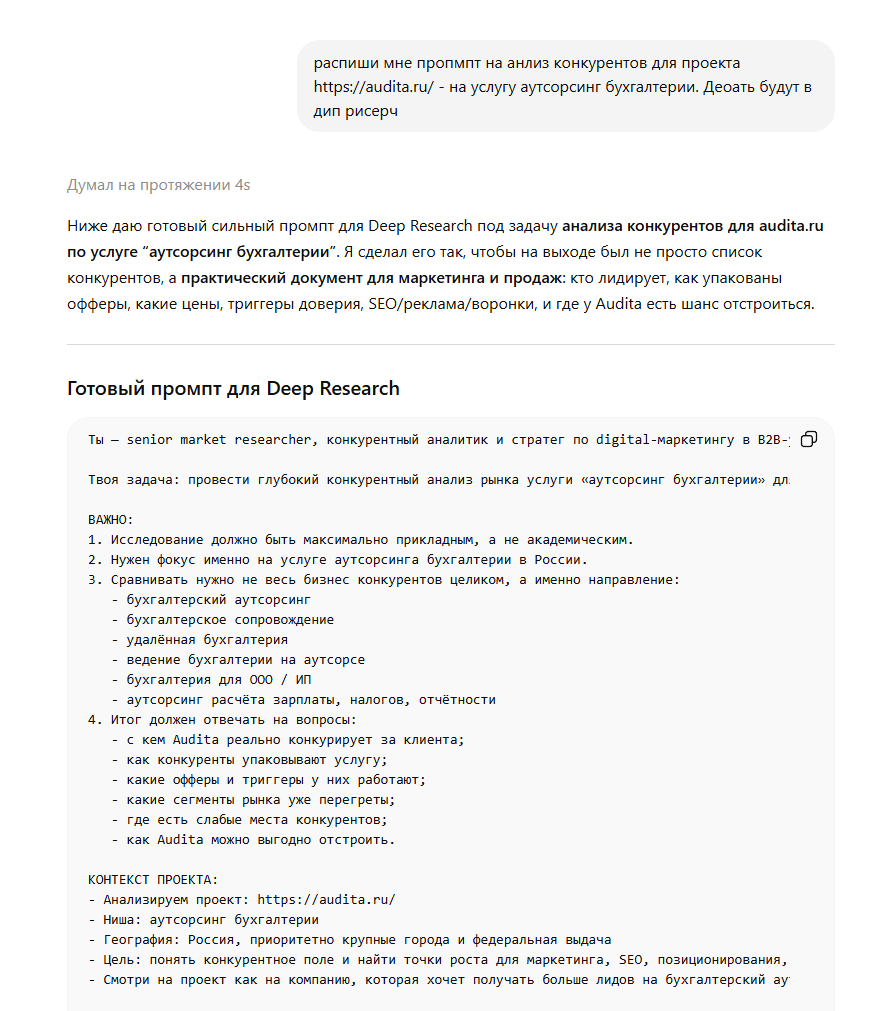
The resulting prompt came out to about 3 pages. I'll provide it in full — adapt it to your niche, replace the service name and link:
Ты — senior market researcher, конкурентный аналитик и стратег по digital-маркетингу в B2B-услугах.Твоя задача: провести глубокий конкурентный анализ рынка услуги «аутсорсинг бухгалтерии» для проекта [ссылка на сайт] и подготовить результат в формате, пригодном для маркетинговой стратегии, упаковки оффера, сайта, рекламы и SEO.ВАЖНО: исследование должно быть максимально прикладным, а не академическим. Фокус — именно на услуге аутсорсинга бухгалтерии в России. Итог должен отвечать на вопросы: с кем мы реально конкурируем за клиента, как конкуренты упаковывают услугу, какие офферы и триггеры у них работают, какие сегменты рынка уже перегреты, где есть слабые места конкурентов, как можно выгодно отстроиться.ЧТО НУЖНО СДЕЛАТЬ:Шаг 1. Определи конкурентное поле: прямые (продают именно бухгалтерский аутсорсинг), косвенные (онлайн-бухгалтерии, подписочные сервисы, юридические компании с бухгалтерским блоком, франшизы), агрегаторы. Сначала длинный список, потом сократи до ТОП-10 прямых, ТОП-5 косвенных, ТОП-5 с самым сильным маркетингом.Шаг 2. Сделай подробную сравнительную таблицу по ТОП-конкурентам. Обязательные столбцы: конкурент / сайт / тип / основной сегмент ЦА / главный оффер / УТП / есть ли цены / есть ли лид-магнит / триггеры доверия / кейсы и отзывы / гарантии / сильные стороны / слабые стороны / что можно позаимствовать / какие уязвимости использовать в позиционировании.Шаг 3. Разбери упаковку каждого сильного конкурента отдельно: позиционирование, оффер, структура сайта, CTA, SEO, рекламные посылы, триггеры доверия.Шаг 4. Сравни клиента с рынком честно: где сильнее, где слабее, чего не хватает на сайте.Шаг 5. Анализ ценовых моделей: тарифы, логика ценообразования, демпинг, премиум.Шаг 6. Найди паттерны, которые повторяются у всех: одинаковые офферы, избитые УТП, шаблонные блоки доверия. Что уже «замылилось».Шаг 7. Предложи не менее 10 вариантов отстройки: по сегменту, специализации, скорости, гарантии, технологии, отрасли, модели оплаты. Для каждого — суть, почему может сработать, сложность внедрения.Шаг 8. Сделай прикладные рекомендации по 5 направлениям: позиционирование, сайт, SEO, реклама, контент и доверие.Шаг 9. Таблица приоритетов: гипотеза / направление / ожидаемый эффект / сложность внедрения / приоритет (high/medium/low) / почему это важно.Формат отчёта: executive summary → карта конкурентного поля → таблица ТОП-конкурентов → подробный разбор сильнейших → сравнение клиента с рынком → анализ цен → паттерны и штампы → возможности для отстройки → рекомендации → таблица приоритетных гипотез → что сделать в первую очередь за ближайшие 30 дней.Стиль: без воды, без общих слов, с конкретикой. Если не нашёл данных — так и пиши, не выдумывай. Приоритет источникам не старше 2 лет.That's it. Copy and go to the AI models.
Time spent: a couple of minutes for a short request — and a ready-made 3-page prompt. Previously such things were written manually and you'd still forget something.
Step 1: The Frankenstein method — one prompt in three AI models
We run the same prompt through three AI models in parallel, then collect the best from each. Sounds excessive — but there's a reason. AI models often contradict each other. Where results coincide — it's probably true. Where they diverge — double-check manually.
Claude
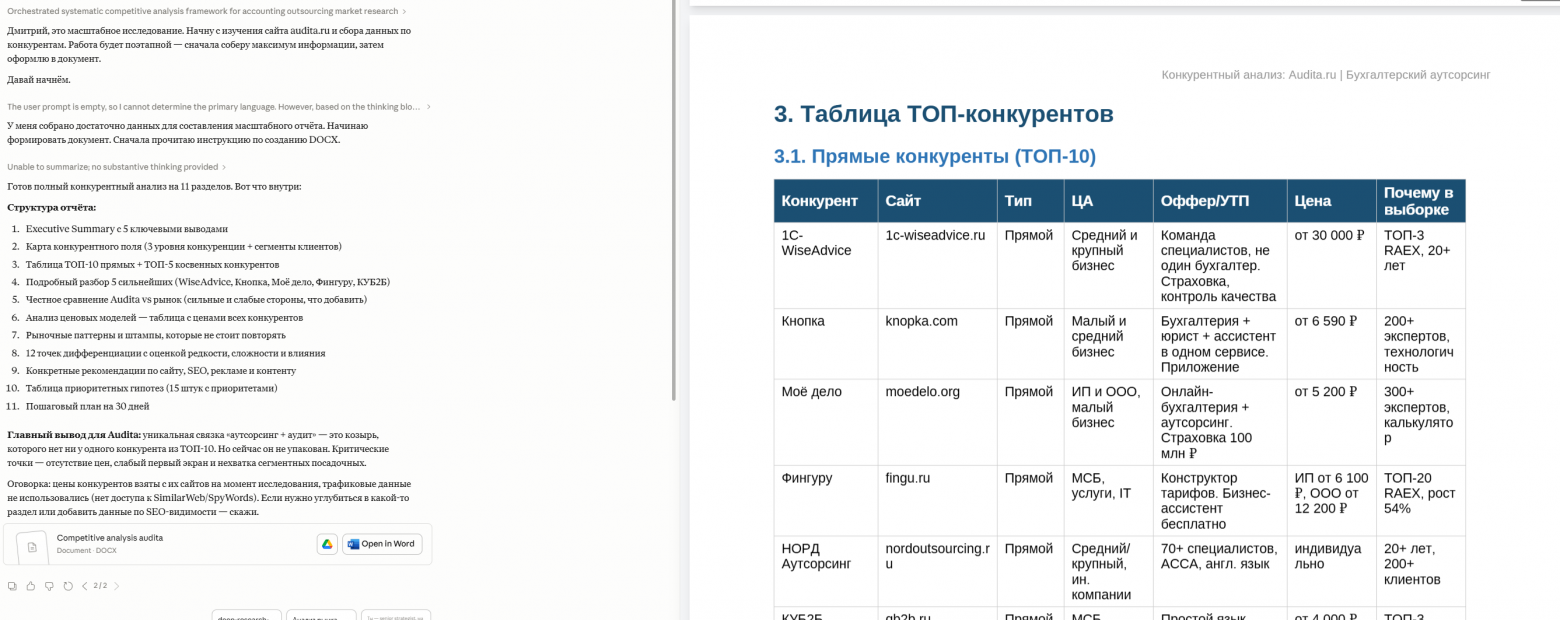
Claude delivered everything according to the prompt structure: competitor profiles, comparison tables, offer analysis, summary.
Interesting findings:
- 90% of websites write the same thing. "Save on taxes," "professional team," "liability is insured." All of them. Literally all. This is no longer a USP, it's noise.
- The client's main trump card, which no one has seized: none of the top competitors offer a bundle of "audit + subscription service" in one package. I wouldn't have paid attention to this myself — you just look at some things, and AI looks at others.
Plus Claude: formats tables cleaner than the rest and exports to Google Docs with one click
ChatGPT (Deep Research)
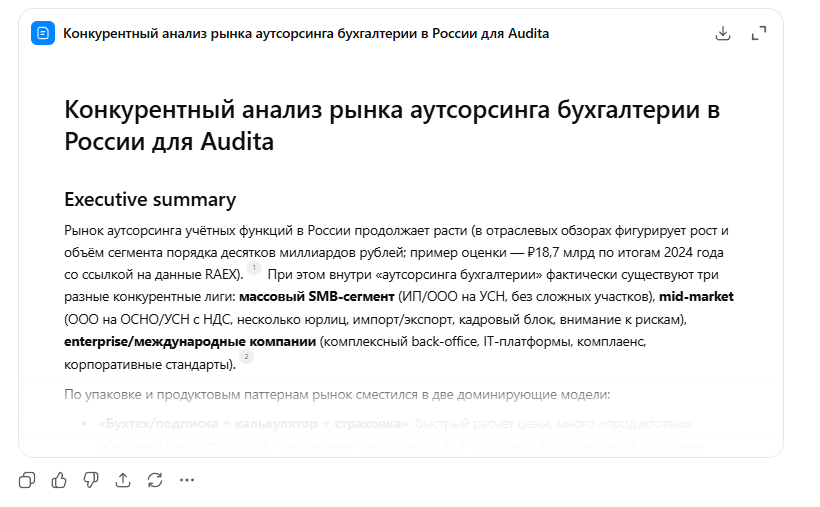
Enable thinking model + deep reasoning. Wait up to 40 minutes — that's how Deep Research works.
Same insights as Claude, but in different words. And that's good: if two neural networks give the same answer — it's most likely not a hallucination or error, but a real fact from open sources.
A specific quote from the accounting results that ChatGPT found on a forum: "Started looking for a company to handle promotion and Direct advertising. High prices, no guarantees." It's not that the neural network made it up — it found it somewhere in entrepreneur discussions.
Important: AI sometimes hallucinates and makes mistakes. For example, it might say a competitor gets 80,000 traffic per month — and be wrong. Or reference a 2019 article as current. Always verify links and dates manually, especially where there are specific numbers.
Gemini (Deep Research)
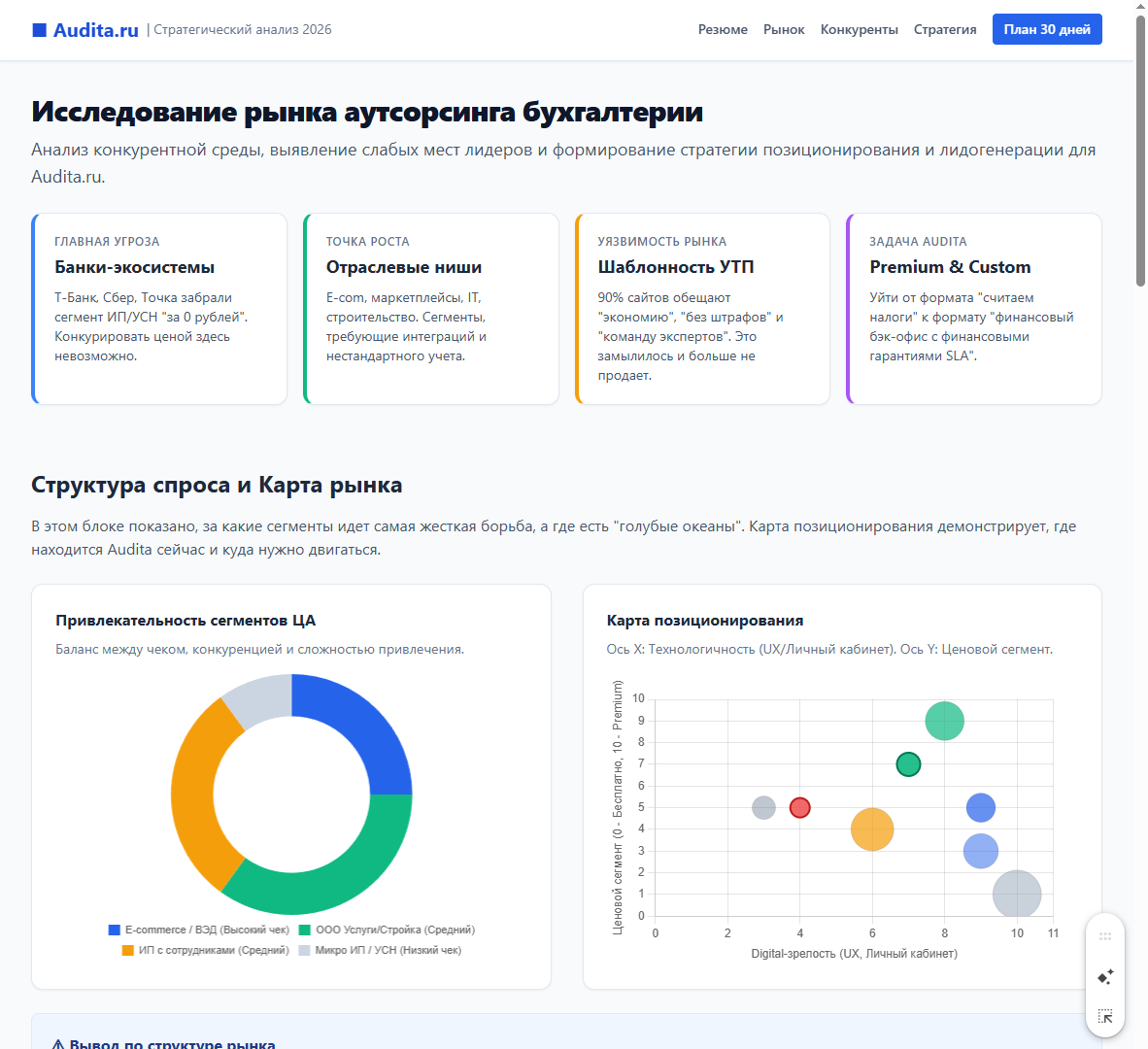
Gemini — verbose as usual. Collects information well, especially sources, but the report is hard to read. Feels like you're reading a dissertation.
But it found three things with numbers that the others didn't:
- The main threat to outsourcers is banks. Sber and Tinkoff give free accounting to small businesses and are slowly eating up the market from below.
- Growth areas — e-commerce, IT, and construction. They have non-standard accounting, and banks can't handle it.
- Untapped niche: comprehensive outsourcing for companies with budgets of 80-170k rubles/month. Major players don't work with these, freelancers don't provide a systematic approach.
And there's a "Create web page" button — click it, get a beautifully formatted HTML report that you can send to a client right now. No Word, no PowerPoint, no designer needed.
Who won?
No one. That's the point of the Frankenstein method — you take the best from each:
- Claude — structure, tables, and export to Google Docs;
- ChatGPT — depth, quotes from real discussions;
- Gemini — numbers, sources, and ready-made HTML for the client.
Step 2: Assembling everything into a presentation
Take the reports from ChatGPT and Gemini, feed both into Claude in one message:
Compile a single presentation for the client from these two reports. Structure: market and trends → audience pain points → competitive landscape → what doesn't work anymore → pricing models → hypotheses for ads and website with prioritizationClaude exports to Google Slides — and you're ready to meet with the client.
What went into the final presentation:
- Market structure and trends
- Four main audience pain points
- Competitive landscape with saturation assessment by segment
- Five identical promises that no longer work
- Three pricing models in the market
- Table of hypotheses for website and advertising with prioritization
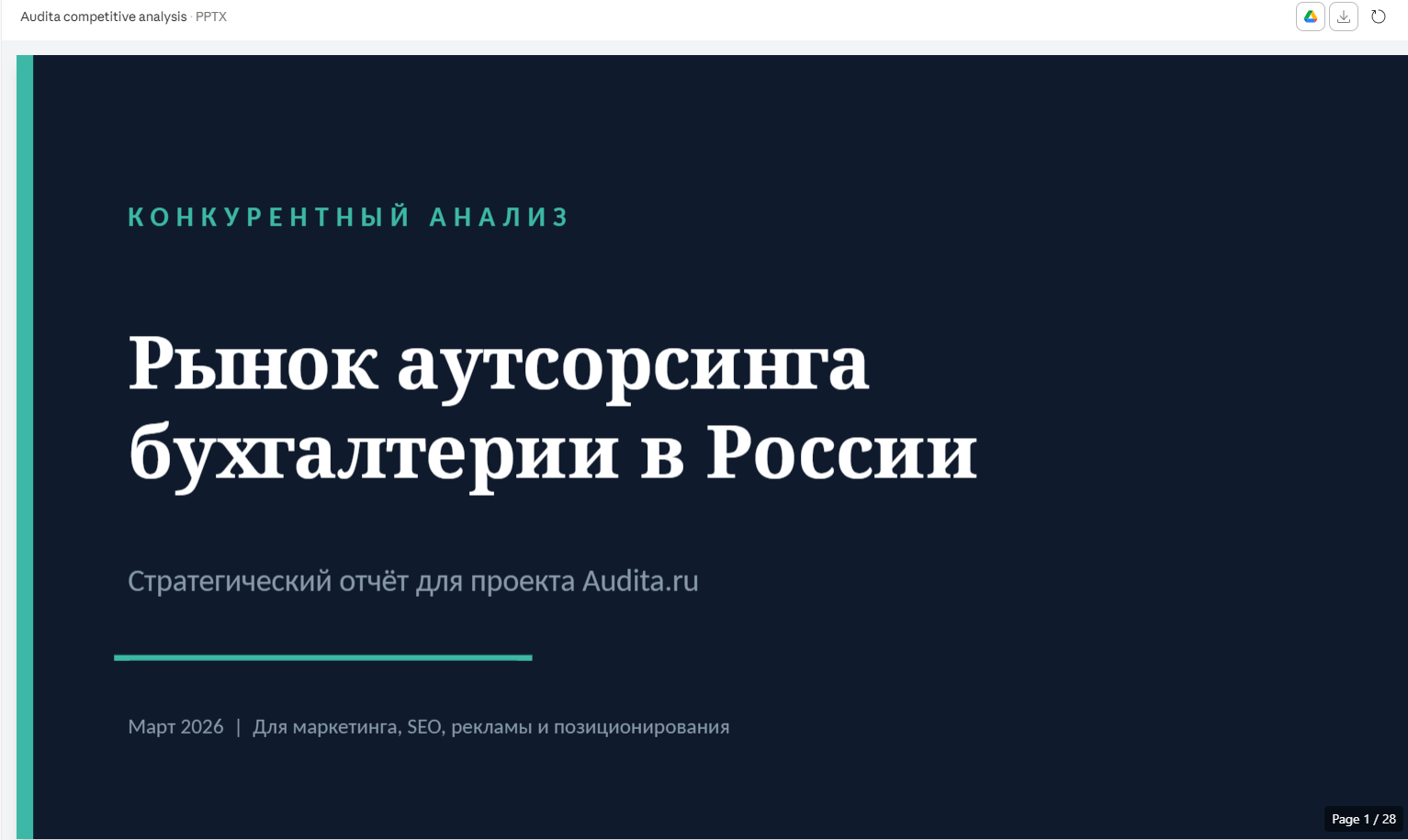
Final Report | Presentation
Time investment:
- Data collection (three neural networks in parallel): 1 hour
- Proofreading and selecting the best: 1-2 hours
- Assembling the presentation via Claude: 30 minutes
- Total: 2.5-3.5 hours
It used to take a week.
Takeaways
- AI doesn't do the analysis for you — it aggregates public information. Humans still do the data verification and final conclusions.
- The method works for any niche: change the service name in the prompt — get analysis tailored to your market.
- Where three neural networks agree on conclusions — it's likely true. Where they diverge — double-check manually.
- Hallucinations are inevitable. Never present client data from an AI report without verifying sources.
Channel with guides and content on claude code, we post news (when limits get slashed) and what tools we implement via claude for projects, channel: https://t.me/claudedevolper